Published on
- 3 min read
How to Read Your Paycheck: Every Line Explained
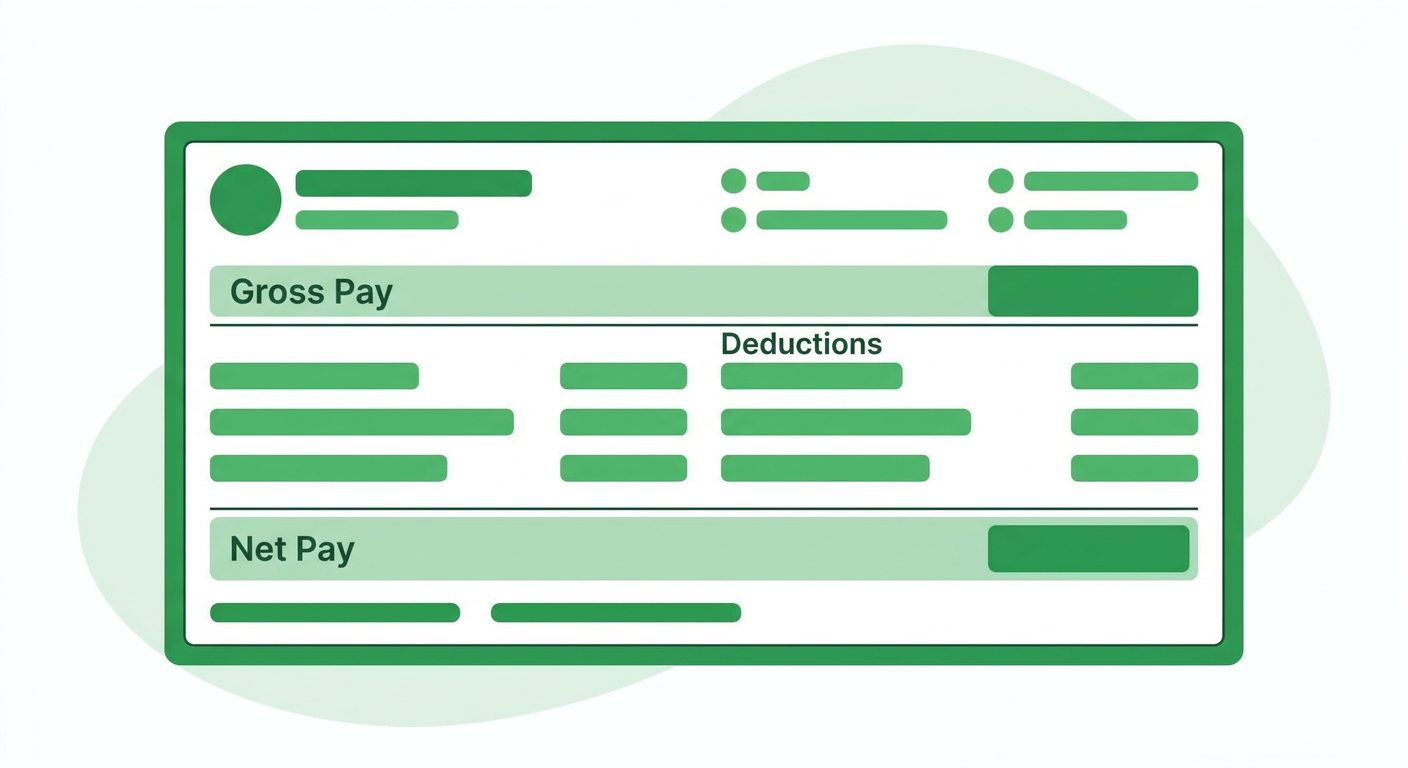
Gross Pay vs. Net Pay
Gross pay is the amount your employer agrees to pay you your salary or hourly rate multiplied by the pay period. Net pay is what actually gets deposited into your account. For a typical American earning $50,000 to $75,000, net pay is usually 70% to 75% of gross. On a $5,000 gross paycheck, you might take home $3,100 to $3,250. The rest has not disappeared it has been assigned to specific purposes.

Federal Income Tax Withholding
Your employer withholds federal income tax based on your W-4 form, IRS withholding tables, and gross earnings. The IRS uses a progressive tax system with seven brackets: 10%, 12%, 22%, 24%, 32%, 35%, and 37% for 2025-2026. These rates apply to taxable income only your first approximately $11,100 (for a single filer in 2026) is taxed at 10%. Only dollars above each threshold are taxed at each higher rate. A common misconception: landing in the 22% bracket does not mean all of your income is taxed at 22% only the dollars above the threshold. The standard deduction for 2026 is approximately $15,100 for single filers and $30,200 for married filing jointly.

FICA: Social Security and Medicare
Social Security is withheld at 6.2% of gross earnings up to a wage base limit. For 2025, the limit is $176,600 if you earn more than that, you pay no additional Social Security tax for the year. Medicare is withheld at 1.45% of all earnings with no cap. An additional 0.9% Medicare tax applies to earnings above $200,000 (single) or $250,000 (married filing jointly). For someone earning $75,000, Social Security withholding is approximately $4,650 per year. The 2026 standard deduction increase from the One, Big, Beautiful Bill is a notable change worth checking against your current withholding.
Health Insurance, Retirement, and Other Deductions
Health insurance premiums are typically deducted pre-tax, reducing your taxable income. For employer-sponsored plans, the average employee contribution is $100 to $200 per month for single coverage, $400 to $600 for family coverage. 401(k) contributions are deducted pre-tax, reducing your current taxable income contributing $6,000 on an $80,000 salary means federal tax is calculated on $74,000. For 2026, the 401(k) contribution limit is $23,500 for employees under 50, with a $7,500 catch-up for those 50 and older. If your employer matches contributions, maxing out to get the full match is an immediate, guaranteed return on your money. Roth 401(k) contributions grow tax-free and are withdrawn tax-free in retirement.

How to Use This Information
The exercise that changes most people’s relationship with their pay is to sit down once with each pay stub and write down every deduction line by line. You will likely find two surprises: deductions you did not know you were paying, and deductions you can actually change. If you are withholding too much on your W-4, you are giving the IRS an interest-free loan and getting a big refund in April money that was yours to use all along. The IRS withholding calculator at irs.gov takes about ten minutes and typically calibrates your withholding accurately. Your paycheck is not just a transaction record. It is a financial statement. Understanding it completely is the first step toward taking control of your income.
Sources: IRS 2025-2026 Withholding Tables, IRS Publication 15-T (Employer’s Tax Guide), Social Security Administration 2025-2026 Wage Base Announcement, One, Big, Beautiful Bill Act (July 2025), ADP Payroll Data 2025-2026, U.S. Bureau of Labor Statistics Employee Benefits Survey 2025.
Related Articles

401(k): Your Employer Is Offering Free Money
Do not leave free money on the table. Learn why employer 401(k) matching is the easiest wealth-build...
How to Read Your Paycheck — And Why It Matters More Than You Think
Learn how to decode your paycheck, understand gross vs net pay, and master the four categories of de...

What to Do With Your 401(k) When You Change Jobs — Without Triggering a Huge Tax Bill
Changing jobs? Your 401(k) has four possible futures. Learn which option saves you money, which cost...