Published on
- 3 min read
The 4-Day Work Week: How Shorter Hours Are Changing American Finance

For decades, the standard American work week has been 40 hours — five days, eight hours each. But a quiet revolution is underway. In 2025 and 2026, more companies than ever are experimenting with four-day work weeks, and the financial implications stretch far beyond what most people expect.
This is not just about working less. It is about a fundamental shift in how Americans relate to their money, their time, and their futures.
The Numbers Are Real
Microsoft Japan ran a month-long experiment in August 2019 called the Work-Life Choice Challenge, shutting down offices every Friday and giving all 2,300 employees the day off without any reduction in pay. When they analyzed the results, productivity — measured as sales per employee — was up nearly 40% compared to the same period the previous year. Electric usage dropped 23%, meeting times and paper printing fell sharply. Ninety-two percent of employees reported satisfaction with the arrangement.
Iceland conducted the largest public-sector trial in history from 2015 to 2019, involving 2,500 workers — roughly 1% of the country’s workforce. Workers reduced their hours from 40 to 35-36 per week with no reduction in pay. The result: productivity either maintained or improved while worker well-being increased significantly. Following the trial, unions negotiated new working arrangements, and today 86% of Iceland’s workforce has either transitioned to shorter hours or has the right to do so.
What It Means for Your Finances
The financial implications of a four-day work week are complex and depend heavily on how the policy is implemented.
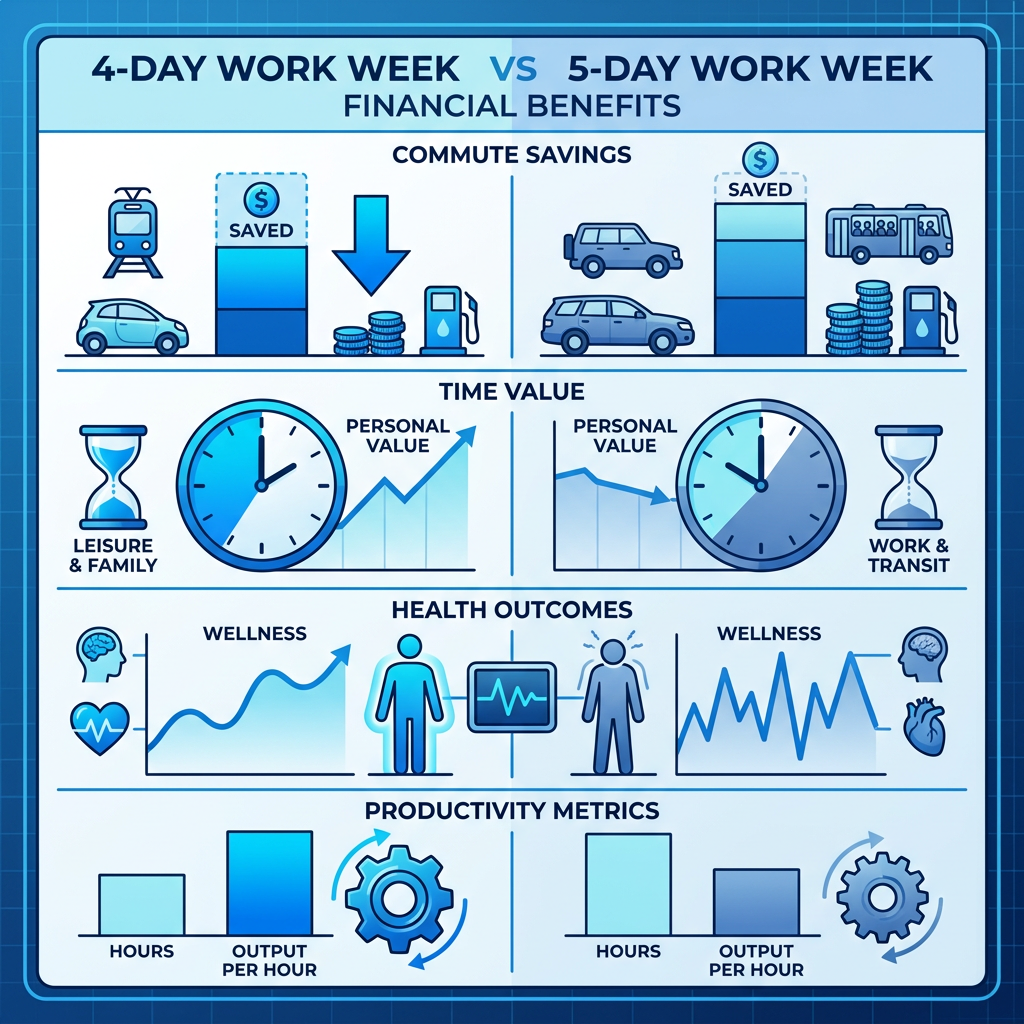
Same pay, fewer hours is the ideal scenario for employees. You maintain your income while gaining an extra day for rest, personal projects, family time, or side income. The effective hourly wage increases, and you have more time to cook at home, manage your finances, or pursue education that could increase your earning potential.
Compressed schedules — 40 hours in four days — offer less financial benefit but still provide the lifestyle advantage of a three-day weekend. The trade-off is longer, more exhausting workdays.
Reduced pay for reduced hours is the riskiest scenario. A 20% reduction in hours with a 20% pay cut significantly impacts your budget, savings rate, and retirement timeline. For workers living paycheck to paycheck, this is not a viable option.

The Hidden Financial Benefits
Beyond the paycheck, shorter work weeks create financial advantages that are harder to quantify but no less real.
Reduced commuting costs. One fewer day of driving or public transit saves money on gas, parking, fares, and vehicle wear. For the average American commuter, that is $50 to $150 per month.
Lower childcare expenses. Parents who work four days instead of five may save one day of daycare or after-school care costs — often $200 to $400 per month.
Health cost savings. Overwork is linked to higher rates of burnout, anxiety, and physical health problems. A shorter work week reduces these risks, potentially lowering healthcare costs over time.
More time for side income. An extra day off gives you time to pursue freelance work, start a small business, or develop skills that increase your market value.
The Bottom Line
The four-day work week is not a magic solution, and it is not suitable for every industry or every worker. But the data is clear: when implemented thoughtfully, it can increase productivity, improve well-being, and create meaningful financial benefits for employees.
For American workers, the question is not whether the four-day week will become standard — it is when. Companies that adopt it early may gain a competitive advantage in hiring and retention. Workers who negotiate for it successfully may find themselves with more time, more money per hour, and a better quality of life.
The future of work is fewer hours. The financial implications are just beginning to unfold.

Related Articles

The 50/30/20 Budget Rule: Your Simple Blueprint for Financial Freedom
Learn the simple 50/30/20 budgeting method that helps you allocate your income wisely without compli...

6 Costly Money Mistakes Most Americans Make
Learn about the six most common and expensive financial mistakes that keep Americans broke, and how ...

How to Save $1,000 a Month: A Realistic Guide
A practical, step-by-step guide to saving $1,000 per month without extreme frugality or sacrificing ...